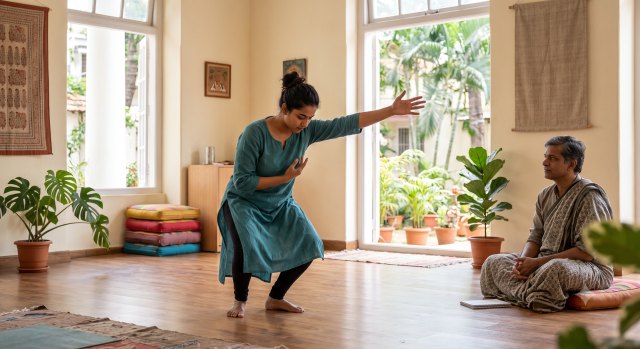
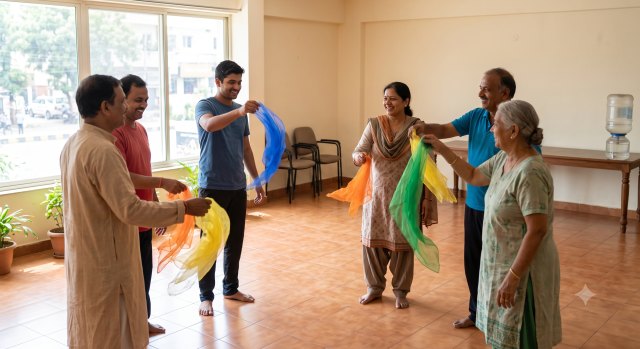
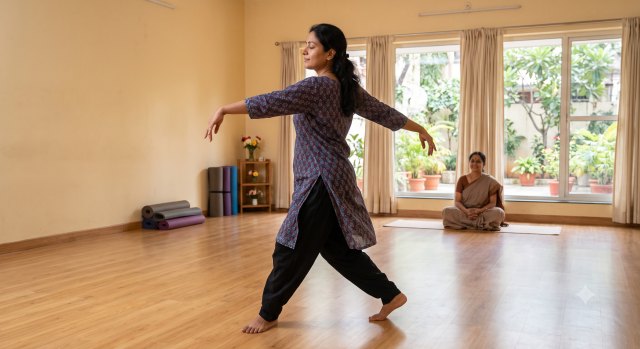
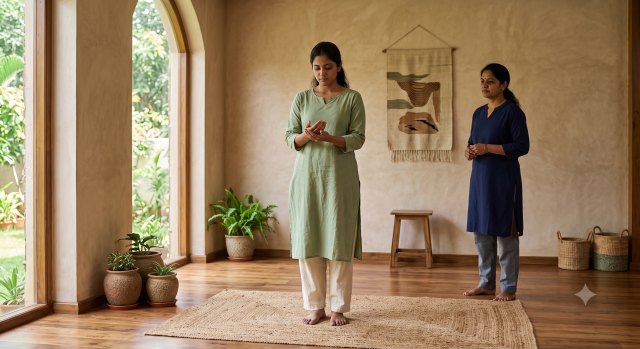
Learn. Move. Express. Connect.
What if movement could become more than exercise?
What if a simple step, stretch, sway, breath, smile, or dance could help a person understand themselves better?
This is the beautiful idea behind Dance Movement Therapy, often called DMT.
The Online Dance Movement Therapy Course by Savio DSilva Classes (in association with Enoma) is created for people who want to explore the connection between movement, emotions, communication, awareness, and human well-being.
This DMT course on SDC trains you to become a DMT Facilitator.
You can conduct your own DMT sessions and workshops on course completion.
For children.
For elders.
For corporate employees.
And for anyone else interested in DMT.
To join this Dance Movement Therapy course...
You do not have to be a professional dancer.
You do not have to know difficult dance steps.
You do not need to perform on a stage.
You simply need an interest in people, movement, learning, and personal growth.
This course takes you step by step into the world of Dance Movement Therapy. It starts with simple ideas and slowly introduces you to more detailed skills, activities, techniques, communication methods, counselling concepts, empathy, body language, somatic awareness, Tai Chi, laughter-based activities, group work, and much more.
This Savio DSilva Classes (SDC) course is completely online.
You can learn from your home.
You can study in your own time.
You can go through the lessons again when you need to.
And you can slowly build your understanding during your course journey.
Welcome to a course where the body is not only something that moves.
It is also something that communicates.
What Is Dance Movement Therapy?
Dance Movement Therapy is based on a very simple idea.
Our body and our feelings are connected.
When we feel happy, our body may become light and active.
When we feel nervous, our shoulders may become tight.
When we feel tired, our movements may become slow.
When we feel excited, we may want to jump, clap, walk quickly, dance, or move our hands.
Our body is always giving us clues.
Dance Movement Therapy explores these clues through movement.
In DMT, a person may use simple movements, rhythm, music, breathing, body awareness, creative exercises, or guided movement activities.
The purpose is not to create a perfect dance.
There is no need to copy a famous dancer.
There is no competition.
There are no marks for beautiful steps.
The movement can be large or small.
A person may walk.
A person may stretch.
A person may move their hands.
A person may gently sway.
A person may follow a rhythm.
A person may sit and make small movements.
Every person is different, so every movement experience can also be different.
That is one of the most important things to understand about DMT.
Movement is personal.
DMT Is Not About Being a Great Dancer
Many people hear the words "Dance Movement Therapy" and immediately think:
"But I cannot dance!"
That is okay.
This course is not about preparing you for a dance competition.
It is not about perfect choreography.
It is not about learning complicated steps.
It is all about training you to conduct DMT sessions on your own.
Whether for kids, young women, working people or senior citizens.
Dance Movement Therapy looks at movement in a much wider way.
A person who can walk can move.
A person who can move their hands can move.
A person who can change their breathing can explore movement awareness.
Even very small movements can become meaningful.
The goal is to notice.
To explore.
To communicate.
To listen.
To connect.
And to learn how movement activities may be used thoughtfully with different people and groups.
Become a More Aware DMT Facilitator
A Dance Movement Therapy Facilitator does more than play music and ask people to dance.
A good facilitator watches carefully.
A good facilitator listens.
A good facilitator communicates clearly.
A good facilitator respects personal space.
A good facilitator learns how different people may respond differently.
A good facilitator understands that every person has their own story, feelings, comfort level, abilities, and boundaries.
This is why the SDC course goes beyond dance.
You learn about movement.
But you also learn about empathy, counselling skills, listening, body language, focus, discipline, somatic awareness, laughter-based activities, Tai Chi, and group facilitation.
These areas help you understand the larger role of a facilitator.
Who Can Join This Course?
The course can be useful for people from many different backgrounds.
Dance teachers may want to explore a different side of movement.
Yoga instructors may want to understand creative movement activities.
Fitness trainers may want to learn more about body awareness and communication.
Teachers may find new ways to conduct movement-based activities.
Social workers and caregivers may want to understand how movement can support connection and participation.
Counsellors may want to explore non-verbal forms of expression.
Artists, actors, dancers, and choreographers may enjoy studying movement in a new way.
Doctors, nurses, psychologists, therapists, and other professionals may find the subject interesting as additional educational learning, while continuing to work within the professional scope and regulations that apply to their own field.
The course may also interest parents, sports professionals, corporate trainers, activity coordinators, and people who simply love movement.
Most importantly, you should have curiosity.
You should want to learn.
And you should be ready to study DMT as more than just dance.
What Will You Learn?
The SDC Dance Movement Therapy curriculum covers a wide range of subjects.
The course includes the following major areas:
1. Introduction to Dance Movement Therapy – Understand the basic meaning, purpose, ideas, and scope of DMT.
2. Dance and Its Importance – Explore why human beings have danced across cultures, communities, celebrations, rituals, and different periods of history.
3. Benefits and Uses of DMT – Study the many ways movement activities may support participation, creativity, awareness, expression, social interaction, and general well-being.
4. DMT Techniques – Learn a large collection of movement techniques and understand how different activities can be introduced.
5. DMT Activities – Explore hundreds of activity ideas and learn how movement sessions can be planned.
6. Group Movement Therapy – Learn how movement experiences can be organised for small and larger groups.
7. DMT With Children – Explore playful and age-appropriate movement ideas for working with children.
8. DMT With Adults – Understand how movement activities may be adapted for adult participants.
9. DMT With Elderly People – Learn about gentler, respectful, ability-aware approaches for older participants.
10. DMT in Corporate Settings – Explore movement-based sessions that may be used as part of suitable employee engagement, wellness, or group activities.
11. Basic Somatic Healing and Somatic Awareness – Learn introductory ideas related to awareness of the body, movement, breathing, and physical sensations.
12. Counselling Skills – Understand why listening, communication, boundaries, respect, and emotional awareness matter when working with people.
13. Effective Listening – Learn how to give another person your attention instead of only waiting for your turn to speak.
14. Empathy – Explore how to understand another person's point of view while respecting that their experience may be different from your own.
15. Body Language – Learn how posture, gestures, facial expressions, movement, personal space, and other non-verbal signals may affect communication.
16. Laughter Therapy Activities – Explore laughter-based group activities included in the SDC curriculum.
17. Focus and Discipline – Learn habits that can help you prepare, practise, organise sessions, and work more responsibly.
18. Tai Chi – Receive an introduction to movement practices connected with balance, controlled movement, attention, and body awareness.
Start With the Basics
Every strong building needs a strong base.
Learning DMT is the same.
So the course does not expect you to understand everything on your first day.
You begin with basic questions.
What is DMT?
Why is movement important?
Why do people dance?
How can the body communicate without words?
What is the role of a facilitator?
What is the difference between performing a dance and taking part in a movement experience?
These simple questions help you build a clear foundation.
Once the foundation becomes stronger, you can move into techniques, activities, group work, communication, listening, empathy, and other deeper subjects.
The aim is to make the learning journey gradual and easy to follow.
Explore Hundreds of DMT Techniques and Activities
One activity cannot work for every person.
One type of music cannot suit every group.
One movement cannot communicate every feeling.
A skilled facilitator therefore needs many ideas.
The SDC course provides course material covering more than 500 Dance Movement Therapy techniques, exercises, and activities.
Students also receive simple tutorial material for a number of DMT activities.
The purpose of learning many activities is not to use all of them at once.
Instead, it gives you a large toolbox.
Imagine a carpenter.
A carpenter does not use only one tool.
Different jobs need different tools.
DMT facilitation is similar.
Different ages, groups, settings, abilities, and goals can require different approaches.
The wider your knowledge becomes, the easier it may be to think carefully about what activity is suitable for a particular session.
Learn More Than 1,200 DMT Skills
SDC's training material covers a large collection of skills connected with DMT facilitation.
These skills are presented through written learning, audio material, tutorials, exercises, assignments, and other online course content.
Some skills relate directly to movement.
Some relate to communication.
Some relate to observation.
Some relate to listening.
Some relate to planning.
Some relate to personal discipline.
Others are connected with understanding people and creating a respectful environment.
Together, these different areas help students see DMT as a broad subject rather than a collection of dance steps.
Learn Through Simple Online Lessons
Learning becomes easier when information is given in different ways.
Some people like reading.
Some people learn better by listening.
Some understand an activity better when they see it.
For this reason, the SDC course uses different learning formats.
Students receive extensive course notes, HQ audio learning material, multimedia tutorials, assignments, and feedback.
The course material has been built and developed over many years.
The program includes a large written learning library running into thousands of pages and short learning notes, along with tutorial videos and multimedia material.
This makes it possible to learn in small pieces instead of trying to understand everything at once.
Read.
Listen.
Watch.
Think.
Practise.
Then return to the lesson if you need to understand it again.
That is one of the biggest advantages of this online DMT course on SDC.
Why Join Savio DSilva Classes
Savio DSilva Classes has been offering courses since the year 1999.
The flagship courses at SDC include courses in
public speaking, personality development, counselling and more.
Thousands of students have enrolled for these courses at SDC.
Savio DSilva, director and founder of SDC has colossal teaching experience.
He has been a trainer, mentor, and coach since 1999.
And has been teaching since 1996.
Savio DSilva is deeply fond of DMT.
He has personally developed the course modules and course content over a decade.
He has been the director of the DMT course on Enoma from the start.
This is a brand new course at Savio DSilva Classes though.
Put together by a trainer with 25+ years experience in counselling, therapy and soft skills training.
You can't go wrong with this DMT course on SDC.
A 180-Day Learning Journey
The Dance Movement Therapy course is designed as an intensive 180-day online program.
This gives you time to explore the material gradually.
You do not need to try to understand the whole subject in a few days.
Learning takes time.
Practice takes time.
Observation takes time.
Good facilitators continue learning even after a course is complete.
During your course period, try to build a simple study habit.
A little learning done regularly is often better than studying a huge amount in one day and then stopping for several weeks.
Even a few focused hours every week can help you move steadily through your course.
Learn Basic Somatic Awareness
The word somatic may sound difficult.
But the basic idea is simple.
It is about paying attention to the body from the inside.
How are you breathing?
Where do you feel tension?
Are your shoulders relaxed?
How does your body feel when you move slowly?
What changes when you stand differently?
What happens when you pause?
Somatic awareness asks us to notice these small things.
The SDC DMT curriculum includes dedicated learning material on basic Somatic Healing and awareness, including short notes, audio material, and video-based learning.
This part of the course helps students think more carefully about the connection between movement and awareness.
Counselling Skills Matter
Dance Movement Therapy involves people.
And when you work with people, communication matters.
That is why counselling skills form an important part of SDC's course.
Savio DSilva brings extensive counselling experience to the program, and the course includes learning related to communication, empathy, effective listening, and understanding people.
You learn that listening is more than hearing words.
You learn to pay attention.
You learn not to interrupt unnecessarily.
You learn that another person's experience may be very different from your own.
You learn that people need respect.
You learn about boundaries.
You learn that a facilitator should never pretend to know something they do not know.
These lessons are useful not only in DMT.
They can also be useful in everyday life.
Learn Empathy
Empathy means trying to understand how another person may be feeling or experiencing a situation.
It does not mean that you must agree with everything.
It does not mean that you know exactly what another person feels.
It means you listen with care.
Imagine that two people enter the same room.
One may feel excited.
The other may feel nervous.
Both feelings can exist.
A thoughtful facilitator understands this.
Participants should not be forced to feel, move, speak, or respond in exactly the same way.
The empathy training included in the course helps students explore this important idea.
Become a Better Listener
People often think communication means speaking well.
But listening may be even more important.
A facilitator who never listens can easily miss what participants are trying to communicate.
Sometimes people communicate with words.
Sometimes they communicate with their face.
Sometimes they communicate with posture.
Sometimes they become quiet.
Sometimes they move closer.
Sometimes they move away.
Sometimes they simply say, "I do not want to do this."
A responsible facilitator pays attention.
SDC includes extensive learning on effective listening, with many practical tips designed to help students develop stronger listening habits.
Understand Body Language
Before people say a word, their bodies may already be communicating.
A smile may show friendliness.
Folded arms may have many meanings.
Looking away can have many meanings too.
A person may stand confidently.
Another may prefer more personal space.
This is why body language must be studied carefully.
It is not a magic code.
One gesture does not always have one meaning.
Context matters.
Culture matters.
The person matters.
The situation matters.
The course introduces students to body language so they can become more thoughtful observers and communicators.
Explore DMT With Different Age Groups
A movement activity for a group of young children may not be suitable for elderly participants.
An activity designed for energetic adults may need changes before it is used with another group.
Good facilitation means adapting.
When working with children, activities may involve imagination, rhythm, simple instructions, games, storytelling, or playful movement.
When working with adults, the approach may be different depending on the group and setting.
With elderly participants, comfort, mobility, balance, pace, personal choice, and physical limitations become especially important.
The aim is not to force everybody to complete the same movement.
The aim is to create an experience in which people can participate safely and comfortably according to their own abilities.
Learn About Group Movement
Moving alone can feel very different from moving with other people.
A group can create energy.
People may copy one another.
They may create a rhythm together.
They may form patterns.
They may take turns leading.
They may work in pairs.
They may communicate without speaking.
A facilitator needs to understand how groups behave.
Some people love being in the centre.
Some prefer staying at the side.
Some may participate quickly.
Others may take more time.
The Group Movement Therapy section helps students explore ways of organising and guiding movement-based group experiences while respecting different comfort levels.
Discover Tai Chi
Tai Chi has been added to the SDC Dance Movement Therapy curriculum as another area of movement learning.
Tai Chi often uses slow and controlled movement.
It can encourage attention to posture, balance, breathing, and the flow of movement.
For a DMT student, studying another movement tradition can broaden the way you think about the body.
Movement does not always need to be fast.
It does not always need loud music.
Slow movement can also require concentration, awareness, and control.
Explore Laughter-Based Activities
Laughter can change the feeling inside a room very quickly.
One person laughs.
Another smiles.
Soon, a whole group may feel different.
SDC includes Laughter Therapy activities as part of its wider DMT curriculum.
Students can explore how suitable laughter-based exercises may be introduced as playful group activities.
As with any activity, participation should be voluntary and appropriate for the people involved.
The aim is not to force happiness.
It is to understand another kind of human expression and group interaction.
Focus and Discipline
Learning hundreds of ideas is useful.
But knowledge alone is not enough.
A facilitator must also prepare.
They must arrive ready.
They must think about the group.
They must organise the activity.
They must communicate the instructions.
They must pay attention during the session.
They must continue learning.
This needs focus.
It also needs discipline.
For this reason, SDC includes training material related to both focus and discipline.
These subjects may sound simple, but they can strongly affect the quality of your work.
Build Your Own Style as a DMT Facilitator
You do not need to become a copy of another facilitator.
You can learn principles, techniques, structures, and activities.
But your personality will still be your own.
One facilitator may be calm and gentle.
Another may have a lot of playful energy.
Another may be very organised.
Another may be especially good at explaining activities.
The important thing is to build your style on a strong foundation of knowledge, respect, preparation, empathy, listening, and responsible practice.
Confidence should grow from learning.
Not from pretending to know everything.
Personal Guidance During Your Course
Online education does not have to mean learning completely alone.
SDC places importance on communication between students and the people guiding the program.
Savio DSilva, the director of SDC, personally mentors and communicates with students on a regular basis.
He is personally involved in every step of the training process, and students receive feedback directly from him.
His assignments also help you think about what you have studied instead of only reading information and moving to the next page.
Good education is not simply about collecting notes.
It is about understanding what those notes mean.
The mantra of SDC is understanding, not just knowing.
Course Material That Keeps Growing
Dance Movement Therapy is a wide subject.
There is always more to learn.
SDC has continued to develop and update its DMT learning material over the years.
Students receive access to an extensive collection of notes, audio learning, multimedia tutorials, videos, techniques, exercises, activities, and supporting lessons across areas such as empathy, focus, body language, counselling skills, somatic awareness, and movement.
The aim is to take you from simple introductory concepts toward a much broader understanding of DMT facilitation.
What Can You Do After Completing the Course?
On course completion, you can offer your own DMT sessions.
You can conduct corporate workshops and offer online sessions too.
You can provide DMT sessions to children, teens, women and senior citizens.
Many students join a DMT course because they want to add movement-based work to what they already do.
A dance teacher may add suitable movement awareness sessions.
A yoga teacher may use new group activity ideas.
A teacher may understand creative movement better.
A counsellor may gain additional knowledge about non-verbal expression while remaining within their professional scope.
A fitness professional may explore a different way of looking at movement.
An activity coordinator may develop new session ideas.
Other students may wish to conduct independent DMT-inspired workshops, classes, awareness sessions, or group activities where appropriate.
Your exact professional opportunities will usually depend on your existing qualifications, experience, location, employer requirements, the people you work with, and the laws or professional rules that apply to you.
Receive Your SDC Dance Movement Therapy Certificate
Students who successfully complete the program receive a Certificate in Dance Movement Therapy from Savio DSilva Classes.
The certificate recognises completion of SDC's training program.
Certificates are sent by courier on successful course completion, with the courier cost included in the course fee.
A course certificate should always be understood correctly.
It shows that you have completed this particular educational program.
It allows you to offer your own services and workshops as a DMT Facilitator.
It does not automatically make you a doctor, psychologist, psychotherapist, or other licensed healthcare professional.
Students should always work within their qualifications, competence, local laws, and professional scope.
That is an important part of responsible DMT facilitation.
You Do Not Need to Become Someone Else
There is something wonderful about movement.
Two people can hear the same music and move in completely different ways.
That is fine.
There is no need to become another person.
There is no need to move like a celebrity.
There is no need to compare your body with anyone else's body.
There is no need to make every movement beautiful.
DMT encourages us to become curious about movement rather than judge it.
What happens when you slow down?
What happens when you stretch?
What happens when you breathe deeply?
What happens when you move with other people?
What happens when the music changes?
What happens when you close your eyes, when appropriate and safe, and simply notice your breathing?
Small questions can lead to interesting discoveries.
DMT and Responsible Practice
Dance Movement Therapy is an interesting and meaningful field of study.
But responsible practice is important.
Movement activities should respect the participant's comfort, health, ability, personal space, and choice.
A participant should never be pressured to share private feelings.
A person should not be pushed into a movement that causes pain.
Medical and mental health conditions should be handled by properly qualified professionals.
A DMT course should not be used as a replacement for medical care, psychological treatment, physiotherapy, emergency support, or other professional healthcare.
If a participant needs support outside your training, responsible facilitation means recognising that limit and referring them to an appropriately qualified professional.
Knowing your limits is not a weakness.
It is part of being responsible.
Why Study DMT Online?
Online learning gives you freedom.
You do not have to travel to a classroom every day.
You do not have to leave work for several months.
You do not need to live in the same city as the course directors.
Your learning material can travel with you.
You can read during a free hour.
You can listen to audio lessons when appropriate.
You can watch a tutorial again.
You can return to an earlier lesson.
You can make your own notes.
You can slowly build your understanding during the 180-day course period.
This format can be especially useful for working professionals, teachers, dancers, fitness instructors, caregivers, counsellors, parents, and other busy learners.
Is This Course Only for Professional Dancers?
No.
You do not need professional dance training to study the course.
Dance experience can certainly be useful, but the subject goes far beyond dance performance.
DMT includes movement awareness, communication, observation, group facilitation, body language, empathy, listening, counselling-related skills, creative activities, and other areas.
A person who loves movement and enjoys learning about people may find the subject fascinating even without a professional dance background.
Will I Have to Perform?
This is an educational training program, not a stage performance course.
The goal is understanding Dance Movement Therapy and facilitation.
Movement practice may naturally form part of studying a movement-based subject, but the purpose is learning rather than showing off perfect dance skills.
Can Teachers Study DMT?
Yes.
Teachers already work closely with people and groups.
Learning about movement, observation, communication, listening, group activities, empathy, and body language may give teachers another perspective on how people participate and express themselves.
How those ideas are used in a school should, of course, follow the school's own policies and safeguarding requirements.
Can Counsellors Study DMT?
Yes.
Counsellors may be especially interested in learning about movement and non-verbal communication.
The course also includes counselling skills, empathy, effective listening, and body language.
However, studying DMT does not replace any professional licence, degree, registration, supervision, or qualification required for clinical mental health practice.
Can Fitness and Yoga Professionals Join?
Yes.
Fitness trainers, yoga instructors, sports professionals, and other movement-based professionals may find many of the course ideas familiar while also discovering new ways of thinking about movement.
DMT looks beyond fitness alone.
It asks us to notice expression, participation, communication, rhythm, awareness, connection, and individuality.
Can I Study at My Own Pace?
The program is designed as an online 180-day or 6 months course.
This means you can organise much of your study around your own daily schedule while completing the required course work within the course period.
Students who create a regular study habit usually find large courses easier to manage.
Do a little.
Learn it properly.
Then move forward.
What Makes the SDC DMT Course Different?
The SDC course does not look at Dance Movement Therapy as dance alone.
The curriculum connects movement training with many other areas that a facilitator may need to understand.
You study DMT techniques and activities.
You study group movement.
You explore different age groups.
You learn basic somatic concepts.
You study empathy.
You study counselling skills.
You improve listening.
You explore body language.
You learn about focus.
You learn about discipline.
You are introduced to Tai Chi.
You explore laughter-based activities.
Most importantly, you learn how to conduct DMT sessions entirely on your own.
Whether for kids, teens, adults or senior citizens.
You work through a large library of notes, audio learning, tutorials, exercises, and assignments.
Together, these areas create a broad learning experience.
Your Journey Starts With One Small Step
Nobody learns a large subject in one day.
You begin with one lesson.
Then another.
One idea becomes clear.
Then a second idea.
Slowly, pieces begin joining together.
You begin noticing movement differently.
You begin listening differently.
You may begin noticing your own body language.
You may start paying more attention to how people respond in groups.
You may think more carefully about personal space.
You may become more aware of the difference between guiding someone and controlling them.
This is what learning can do.
It changes the things we notice.
And once you notice something clearly, it becomes difficult to stop seeing it.
Learn to Guide Without Judging
One of the most valuable qualities a facilitator can develop is an open mind.
People move differently.
People learn differently.
People communicate differently.
Some participants may be very expressive.
Some may be quiet.
Some may love music.
Some may prefer gentle movement.
Some may enjoy group interaction.
Others may need more personal space.
A facilitator should not treat these differences as mistakes.
The goal is not to turn every person into the same kind of participant.
The goal is to create a thoughtful environment where suitable movement and participation can happen with respect.
Movement Can Be Simple
A meaningful movement activity does not always require a large room.
It does not always require loud music.
It does not always require difficult equipment.
Sometimes the smallest actions help us notice the body.
A breath.
A pause.
A shoulder movement.
A slow stretch.
A change in posture.
A rhythm made with the hands.
A step forward.
A step back.
Movement begins with the body you already have.
That simplicity is part of what makes the study of movement so interesting.
Study DMT With SDC
The SDC Online Dance Movement Therapy Course brings together years of course development and a large collection of learning material.
The program is designed to introduce beginners to the foundations of DMT while also giving serious students a substantial amount of material to explore during their course tenure.
You will not simply study dance.
You will study movement.
You will study people.
You will study communication.
You will study listening.
You will study empathy.
You will study awareness.
You will study effective facilitation.
And you will learn why responsible practice matters.
Take the Next Step
If movement interests you, explore it.
If working with people interests you, learn more about them.
If dance brings you joy, discover another side of dance.
If you are already a teacher, counsellor, dancer, fitness trainer, yoga instructor, social worker, caregiver, healthcare professional, artist, coach, activity coordinator, or movement professional, DMT may give you a new subject to study alongside your existing skills.
And if you are simply curious, curiosity is a good place to begin.
You do not need to know everything before you start.
That is what a course is for.
Start with the basics.
Learn one idea at a time.
Move at a steady pace.
Ask questions.
Practise responsibly.
Listen carefully.
Respect the people you work with.
And keep learning.
Are You Eligible For SDC's DMT Course?
Do you hold a college or bachelor's degree in any discipline?
Are you genuinely interested in Dance Movement Therapy?
Can you give few hours a week to the course?
If you answered "Yes" to all three questions then you are eligible for this course.
Enrol in the SDC Dance Movement Therapy Course
Begin your 180-day learning journey into Dance Movement Therapy with Savio DSilva Classes.
Register today, upload your document copies, pay the fees and receive access to the secure course area within a few hours.
Then take the next step...
Open your first lesson.
Read or listen to it.
Open your second lesson.
Then the third and so on.
Learn. Explore. Discover. Complete the course.
Then offer DMT sessions to others.
During the course, you will...
Explore movement.
Understand facilitation.
Develop your communication skills.
Study empathy and listening.
Discover DMT techniques and activities.
Learn about body language, somatic awareness, Tai Chi, focus, discipline, group movement, and much more.
Your first step does not need to be a big one.
It only needs to move you forward.
Join the Online Dance Movement Therapy Course at SDC and begin your DMT learning journey today.
* Course fees scheduled to increase in the near future.
Call 9820 262 263 or Contact Us online for queries.